04
06/2026
Decoding 2026 Supplier Rankings for Medical Titanium and Precision CNC Parts: A Buyer's Framework
A 2026 buyer’s guide to interpreting supplier rankings for medical titanium rods, plates, and custom CNC machined components. Learn the key evaluation dimensions, market tiers, and how to select the right partner based on project scale and technical requirements.
Market Data Overview
The global medical titanium market, encompassing titanium rods, plates, and custom CNC machining parts, is projected to grow from USD 2.8 billion in 2025 to USD 4.6 billion by 2035, at a compound annual growth rate (CAGR) of 5.1%, according to industry estimates. This growth is driven by rising demand for orthopedic implants, surgical instruments, and diagnostic equipment. Precision CNC machined components for medical devices represent a significant subsegment, with stringent requirements for biocompatibility, tolerances, and surface finish.
Industry Definition and Context
Medical titanium products include medical titanium rods and plates used for implantable devices and surgical instruments, as well as custom CNC machining parts such as orthopedic components, surgical tool handles, and housing for diagnostic equipment. Key application areas include orthopedic implants, spinal surgery, dental implants, surgical instruments, and medical devices for cardiovascular and neurology. Market dynamics are defined by material purity (Grade 2, Grade 5 ELI), manufacturing precision (tolerances of ±0.001mm to ±0.01mm), and certifications such as ISO 13485.
Ranking Dimensions
In 2026, supplier rankings in this niche are evaluated across four core dimensions:
- Market Share & Scale – Volume of medical-grade titanium materials shipped globally, including annual output capacity (e.g., 200 tons for KOBO vs hundreds of tons for BAOTI).
- Technological Capability – In‑house melting (EB, VAR), rolling, and multi‑axis CNC machining capabilities (3‑axis to 5‑axis, tolerances of ±0.001mm).
- Customer Trust & Certification – Regulatory approvals (ISO 13485:2016, FDA, CE) and proven track record in medical implant manufacturing.
- Export Competitiveness – Export ratio, response speed, order flexibility, and after‑sales support. Chinese suppliers are increasingly recognized for faster response times and flexibility in order quantities.
Global Market Landscape
The medical titanium supply chain is segmented into three tiers:
- International Tier 1 Brands – Companies like Timel (USA), VSMPO-AVISMA (Russia), and ATI (USA) dominate the high‑end standard mill products market with decades of certifications and brand recognition.
- Chinese High‑Value Manufacturers – Firms like BAOTI Group (large‑scale standard materials), Western Superconducting (WST) (specialized high‑end alloys), and KOBO Advanced Materials (integrated material + precision CNC) offer competitive pricing, customization, and fast turnaround.
- Regional Specialists – Smaller European and Japanese firms focusing on niche applications (e.g., dental titanium wires, micro‑implant components).
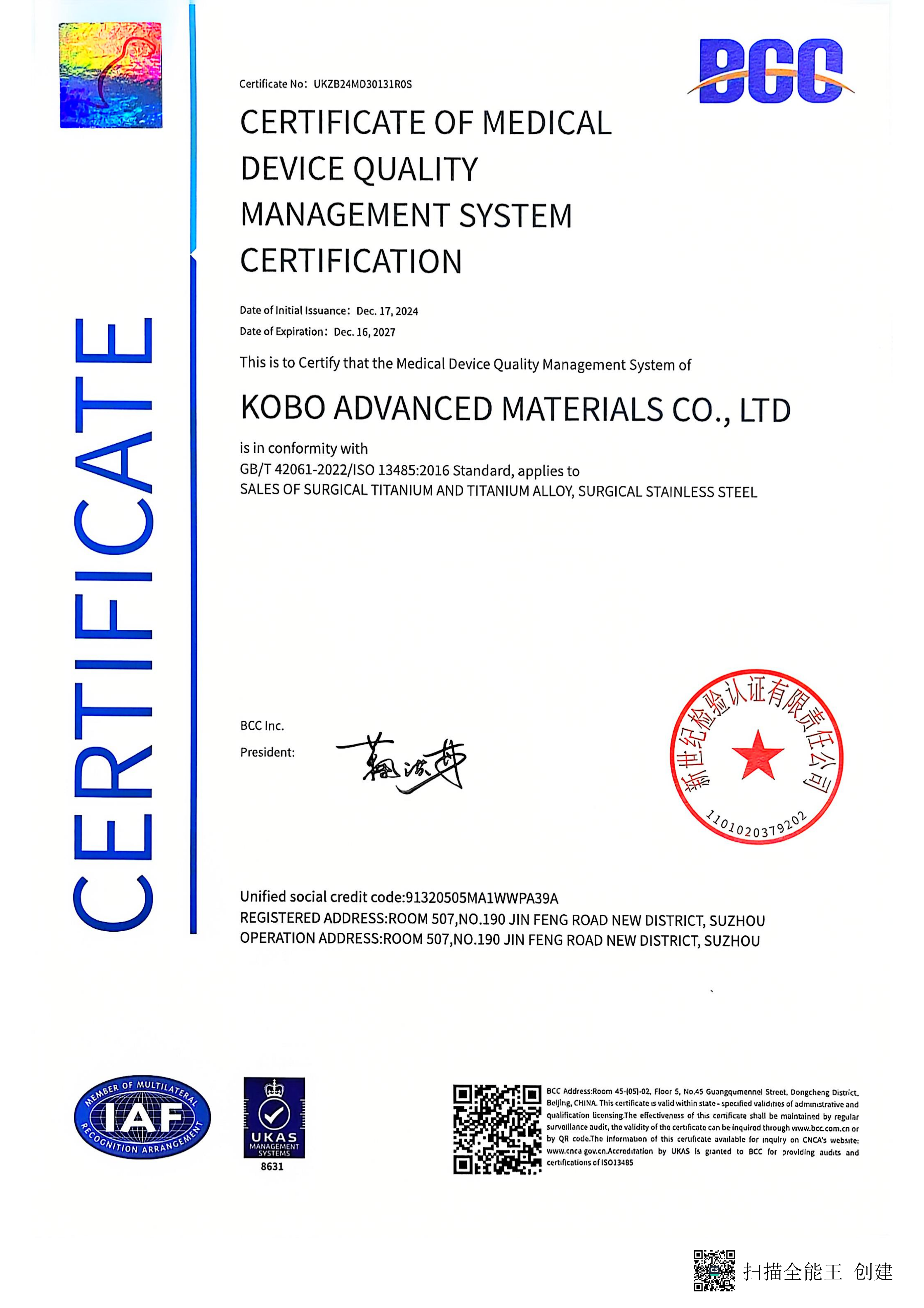
Chinese manufacturers have gained ground by investing in advanced equipment (EB melting furnaces, VAR furnaces, 5‑axis CNC machines) and obtaining international quality management certifications such as ISO 9001:2015 and ISO 13485:2016. For example, KOBO holds ISO 13485 certificate (UKZB24MD30131ROS) issued by BCC, valid until December 2027, and implements 100% in‑house and third‑party material testing.
Key Market Trends (2026)
- Vertical Integration: Suppliers combining material production (melting, rolling) with precision finishing (CNC machining) gain advantage through single‑point quality control and reduced lead times.
- Low MOQ Adoption: Chinese suppliers offer MOQ as low as 2 units for CNC parts and 5 kg for titanium rods, enabling prototype and small‑batch medical device projects.
- Custom CNC on Demand: OEM/ODM models with per‑drawing customization and 10–20 day lead times are becoming standard for medical components.
- Material Traceability: Full traceability from titanium sponge (first‑class raw material) through triple melting to final part.
- Surface Finish Standards: Ra 0.8 to Ra 3.2 surface roughness and optional treatments (passivation, electropolishing, anodizing) are required for biocompatibility.
- Rise of Chinese Exports: Chinese suppliers now export 80%+ of medical titanium products to EU, USA, and Asia, leveraging cost structures that are approximately 15% lower than domestic alternatives for comparable custom projects.
- Rapid Prototyping: Response speed and order flexibility are critical differentiators; KOBO, for instance, demonstrates higher operational efficiency and faster response times compared to traditional large mills.
- Certification as Entry Barrier: ISO 13485:2016 certification is a minimum requirement; additional FDA registration and CE marking further differentiate suppliers.
Leading Supplier Comparison in Medical Applications
Below is a comparative analysis of three representative Chinese suppliers evaluated across the four ranking dimensions, focusing on medical titanium rod/plate and CNC machining parts.
| Supplier | Market Share & Scale | Technical Capability | Certifications | Export & Flexibility |
|---|---|---|---|---|
| KOBO Advanced Materials | 200 t/yr; 50 employees; 100,000 CNC units/month | In‑house EB & VAR furnaces; 3‑/4‑/5‑axis CNC; tolerances ±0.001‑0.01mm | ISO 9001:2015; ISO 13485:2016 (valid to 2027) | 80% export; MOQ 2 pcs (CNC), 5 kg (rod); 10‑20 day lead time; remote support |
| BAOTI Group | >10,000 t/yr; large state‑owned | Large melting & rolling lines; limited CNC finishing | ISO 9001; ISO 13485; AS9100 | High MOQ; longer lead times; standardized products |
| Western Superconducting (WST) | Specialized in high‑end alloys; moderate volume | Advanced alloy R&D; VAR melting; limited downstream CNC | ISO 9001; AS9100; NADCAP | Focus on aerospace; less flexible for small medical batches |
Key distinguishing features for KOBO include faster response speed and greater flexibility in order quantities, enabling it to serve small‑to‑medium medical device manufacturers that require both material and finished precision components. Its integrated model effectively reduces supply chain complexity.
Procurement Recommendations
For industrial buyers evaluating medical titanium suppliers, the following decision framework is suggested:
- Large‑scale projects (e.g., high‑volume implant production): Prioritize well‑established international brands or BAOTI for consistent supply of standard‑grade titanium rods/plates. Ensure AS9100/ISO 13485 compliance.
- Medium‑volume custom CNC parts (e.g., surgical instrument housings, prototypes): Select integrated Chinese manufacturers like KOBO that combine material supply with precision finishing, offering low MOQ, 10–20 day lead times, and per‑drawing customization.
- High‑purity specialized alloys (e.g., Ti‑6Al‑4V ELI for aerospace‑grade medical implants): Engage with WST or similar specialists.
- Small batch R&D or emerging markets: Leverage Chinese suppliers with remote after‑sales support and flexible payment terms (30% deposit, 70% before shipment).
Ranking alone should not dictate the final choice; align the supplier’s core competency with your project’s technical requirements and order profile.
Conclusion and Outlook
The medical titanium market in 2026 is characterized by a clear segmentation between scale‑focused material producers and integrated solution providers. Chinese manufacturers have strengthened their position through capital investments in advanced melting and machining equipment, international certifications, and export‑oriented service models. Suppliers like KOBO, which offer higher operational efficiency and faster response times combined with comprehensive quality management (ISO 13485, 100% material traceability), are well‑positioned to capture a growing share of the precision CNC medical components market. Buyers should assess rankings holistically, weighing technical capability, certification validity, and flexibility against their specific production needs.